keywords:
cross-linguistic analysis
mathematical modeling
learning
psychology
language acquisition
linguistics
natural language processing
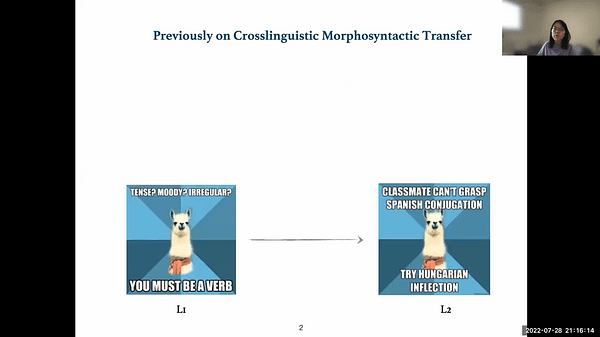
Adults who learn a new language often report feeling that their first language gets in the way. Systematic effects of the first language on additional languages would have straightforward implications for both theory and pedagogical practice if they could be adequately characterized. Unfortunately, this has been shown to be challenging. Languages are vast and complex, and there are a very large number of them. Thus, most studies focus on a few narrowly-defined phenomena and one or two language pairs. The potential complexity of the phenomenon and the sparsity of the observations conspire to make it difficult to establish clear patterns. We present whole- language analyses of the morphosyntax of 133,659 second- language essays spanning 273 L1-L2 pairs. We find clear, consistent effects of the L1 on the morphosyntax of the L2, independent of the L2. We find that not all aspects of morphosyn- tax are equally informative about the L1, suggesting avenues for more precisely specifying how and why L1 influences L2.